

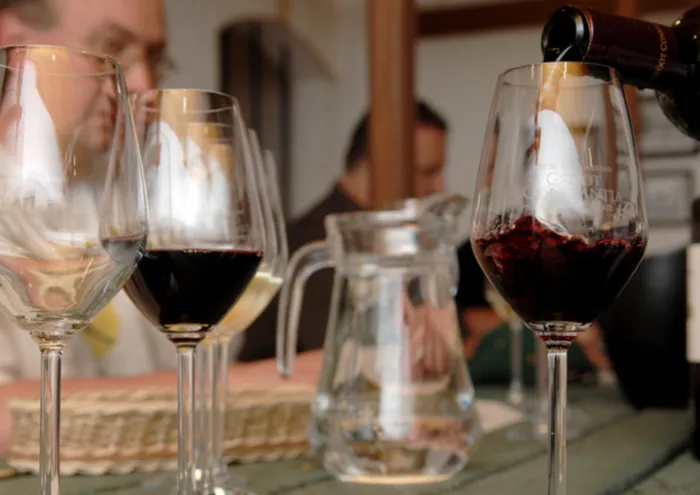
Cape Town-090204-Groot Constantia wine maker Boela Gerber pours a glass of 2007 Pinotage for a tour group from the South of France during a wine tasting in the cellar building of Groot Constantia, where tours and tastings are also held. Photo by Skyler Reid. Cape Town-090204-Groot Constantia wine maker Boela Gerber pours a glass of 2007 Pinotage for a tour group from the South of France during a wine tasting in the cellar building of Groot Constantia, where tours and tastings are also held. Photo by Skyler Reid.
Athens - At a first glance, the crowded tables outside Greece's restaurants might make you wonder about the economic crisis, but a closer look will reveal that customers are opting to forgo fine bottled wine for cheap tipple to save a bit of cash.
The country's debt crisis means many Greeks can no longer afford their favourite wine, so local winemakers - who until recently sold 90 percent of their produce at home - are looking abroad for a much-needed boost in sales.
“There is no question that the bottled wine market in the local restaurant business has hit an all-time low,” Constantine Stergides, the exhibition manager of the Oenorama Wine Trade Show, told dpa, adding that many wineries have struggled for months to collect money owed to them by distributors.
“The recession has come at a bad time - especially since we are now seeing a quality revolution in Greek wines over the past decade that goes beyond making Retsina,” Stergides said, referring to the cheap white wine which once served as the industry's mascot.
Today, Greece's four flagship varieties are the dry white Assyrtiko wines from the volcanic island of Santorini; the white Moschofileo grapes from Mantinia in the north-central Peloponnese; the red Agiorgitiko wines that are integrated into the myths of the nearby Nemea region and the dry red Xinomavro variety of Naoussa and Amynteo in north-western Greece.
At the La Tour Melas winery in central Greece, owner Kyros Melas is set this year to export 60 percent of his boutique red wine - a blend of Merlot, Cabernet Franc and Petit Verdot.
“Greece has finally shed its Retsina image and quality is what is going to help Greece come out of the financial crisis,” said Melas, insisting that many of the smaller estate wines like his were on a par with French and Italian wines.
Melas, who imported vines from France several decades after his grandfather bought land near the ancient village of Echinos in 1962, said Greece would come out of the crisis by increasing its exports of high-quality agricultural products like wine.
“Small wineries which did not over-extend themselves with too many labels should be able make it out of the crisis,” he said.
Greek vintners have been blessed with years of favourable weather conditions, resulting in high yields for the tiny Mediterranean country.
The National Organisation for Vine and Wine says Greek production will reach 3 million hectolitres this year, while exports are expected to rise 10 percent on 2011.
“Wine producers export mainly to Germany, France, the United States and Canada but they are also looking to China and other emerging markets for sales growth,” said Maria Triatafylou, the organisation director.
But Greek winemakers face stiff competition not just from the old world, but also from new wine growers in countries such as Chile, Australia and South Africa who either enjoy low labour costs or have developed a more industrial approach to winemaking.
Yet the competition does not pose a threat to Greece's winemaking giant Tsantali, which owns wineries in Halkidiki, Mount Olympus, Mount Athos, Macedonia and Thrace.
Founded in 1890, Tsantali sells more than half of its wines overseas, while its Kormilitsa Gold from the vineyards of Mount Athos has been selected as the official wine of Moscow's Kremlin.
Besides exports to Europe, Russia, Canada and Brazil, Tsantali has established a strong presence in the Asian market, planning to open more than 100 stores in China by the end of 2012, with the goal of reaching 250 stores exclusively selling its wine labels by 2015.
“The wine industry has been affected by the recession and you need to have an export strategy and vision to survive - anyone who did not foresee this is in trouble now because domestic sales have dropped,” said Tsantali's marketing manager Lily Dimitriou.
Many medium and larger-sized wineries, upset by the recent local demand for cheap bulk wine, have opted to join the competition by launching new economic labels.
“We have a new white and red by Boutaris' Simio Stixis label which are being sold for less than 6 euros,” said Stergides.
Boutaris, which produces more than 40 labels, usually prices wines at up to 14 euros.
Other winemakers, such as Monemvasia Winery in the southern Peloponnese, are demanding that restaurants finally drop overpriced wine lists which they say are turning away customers.
“Although we export nearly 40 percent of our wine ... we do not want to lose the Greek market,” said Monemvasia's marketing manager Elli Tsimbidi.
“Restaurants often mark up a 5-euro bottle of wine to at least 12 euros and this is wrong - we want people to be able to afford and enjoy a nice locally-produced bottle of wine with their dinner,” Tsimbidi said. - Sapa-dpa