

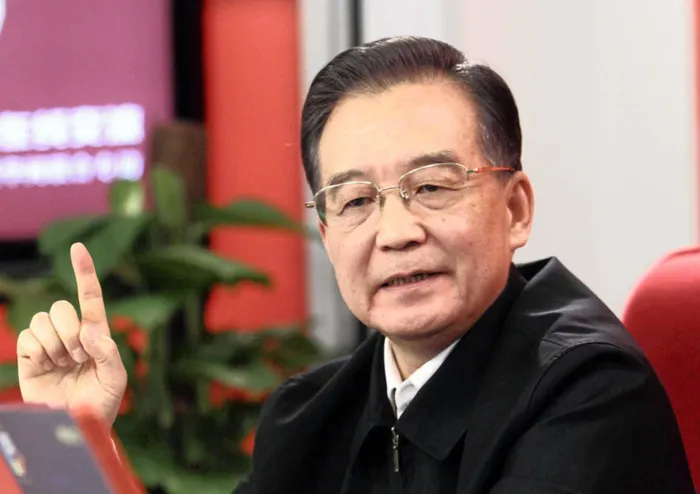
Premier Wen Jiabao believes China should follow a more balanced path because the spectacular growth of the past three decades left the country with "weak economic foundations and uneven development" and too many Chinese without equal access to a good education and health care. Picture: Xinhua. Premier Wen Jiabao believes China should follow a more balanced path because the spectacular growth of the past three decades left the country with "weak economic foundations and uneven development" and too many Chinese without equal access to a good education and health care. Picture: Xinhua.
Each week, it seems, brings fresh evidence of China’s unstoppable rise as a global economic superpower. This year, China officially passed Japan as the world’s second-largest economy. China had already grabbed the title of world’s largest vehicle market and largest maker of cars. China is also on track to become the world’s largest consumer of luxury goods.
China is building the world’s longest high-speed rail network, and this year unveiled its first indigenous supercomputer.
Growth is expected to slow this year, down from a dazzling 10 percent to a more manageable 8 or 9 percent – which would still be the envy of almost any Western nation.
And on September 29 China successfully launched its Tiangong-1 space lab module, the first phase of what will be an eventual manned Chinese space station. The launch came – as the state-run Xinhua news agency helpfully pointed out – as the US, stricken by huge budget deficits, has been scaling back its once-ambitious space programme.
Small wonder, then, that the outward mood among Chinese officials these days, reflected in the editorials of nationalistic newspapers or in meetings with visiting American scholars, is one of self-satisfaction, if not outright triumphalism.
There is talk here of whether China should help bail out struggling Europe by using some of its vast $3 trillion in foreign reserves to buy European sovereign debt.
Compare that with the mood these days in the US, and the contrast is stark.
“I went to your country,” Wu Jianmin, a retired Chinese diplomat, said recently. “The mood is very sour, very depressed.”
Yet just below the surface here, many officials and ordinary Chinese are far more sanguine about the country’s sudden rise to global economic powerhouse. The country may be rich now, and have an infrastructure much of the world envies but China is still a “developing country”, officials and economists insist. And besides, many average Chinese say they personally don’t feel rich at all.
When China surpassed Japan as the world’s second-largest economy, several analysts writing opinion pieces in state-run newspapers pointed out that the milestone was misleading: China was only rich in GDP terms, they said, and most people had yet to feel the benefits.
Prime Minister Wen Jiabao himself has led the cautionary chorus, telling a news conference earlier this year, at the end of the annual meeting of China’s legislature, that the country needed to pursue more “balanced” growth.
The spectacular growth of the past three decades had left China with “weak economic foundations and uneven development”, Wen said. Too many Chinese lacked equal access to a good education and health care, and many had not seen the benefits of China’s dynamic growth.
Many ordinary Chinese seem to agree. “Actually, I don’t think China is rich,” said Luo Ruxi, 24, a recent graduate at Utopia, a left-wing bookshop in Beijing.
“Most of the fortune has been collected by a few enterprises concentrated in a few places – Beijing, Guangdong, Shanghai.”
“The government talks about us getting richer, but 10 years ago, people could afford to see a doctor. Before, they could eat safe food,” Luo said. “Also, look at housing. Ten years ago, we could afford a house. But not now.”
Xu Mingqi, an economist and researcher with the Shanghai Academy of Social Sciences, said comparisons between the US and China are for now overstated. “China’s GDP is only 9 percent of the world’s. The US is 23 percent of the world’s,” Xu said. “The US has more than $40 000 (R320 000) per capita.”
Even some of the government’s prestige projects have drawn more intense scrutiny, and some unusual criticism, in a country where political dissent is largely stifled and the government-controlled media traditionally echoes the official line.
A July 23 collision of two high-speed trains that killed 40 passengers in Wenzhou, in Zhejiang province, unleashed a torrent of critical reporting asking whether officials may have overlooked safety concerns in the race to build the world’s fastest trains and most extensive high-speed network.
After the crash, even the People’s Daily, the official newspaper of the Communist Party, said China did not need “blood-soaked GDP”. And Caixin, a weekly magazine known for hard-hitting investigative reporting, said the Wenzhou crash showed flaws in China’s “authoritarian development model”.
“In this perverse environment, anyone who dared pursue or request patient, meticulous scientific studies of serious technical questions would hit a brick wall,” Caixin said in an editorial.
While citizens are still awaiting the final report on the cause of that collision, another crash between two subway trains underground in Shanghai on September 27, apparently caused by a signal malfunction, triggered a fresh debate about the nationwide boom in subway construction.
Moreover, China’s economic policymakers are trying to grapple with an array of problems overlooked by the strong growth rate.
Most urgent is inflation, now running at an annualised rate of about 6.5 percent. Much of the problem was caused by the government’s $586 billion stimulus programme enacted in 2009 as a response to the global economic slowdown. The stimulus, mostly lending from government-run banks, led to a boom in construction, real estate spending and car sales, but the result has been an overheating of the economy.
Government financial managers are now trying to withdraw the stimulus and arrange a “soft landing” for the economy. – Washington Post-Bloomberg